Leap Years Explained: The Rule and Every Leap Day to 2060
The next leap day is Tuesday, February 29, 2028. Leap years keep our calendar lined up with the seasons, and the rule is slightly more complex than “every four years”.
Key facts
- A year is a leap year if it divides by 4, except century years, which must divide by 400.
- 2000 was a leap year. 2100 will not be.
- There are 97 leap years in every 400 years.
The rule
The Gregorian calendar adds February 29 in every year that divides evenly by 4. Century years (1900, 2000, 2100) are the exception: they are only leap years if they also divide by 400. So 2000 was a leap year, but 1900 was not, and 2100 will not be.
This gives 97 leap years every 400 years, for an average year of 365.2425 days. That is very close to the time Earth takes to go around the Sun from one spring equinox to the next, about 365.2422 days.
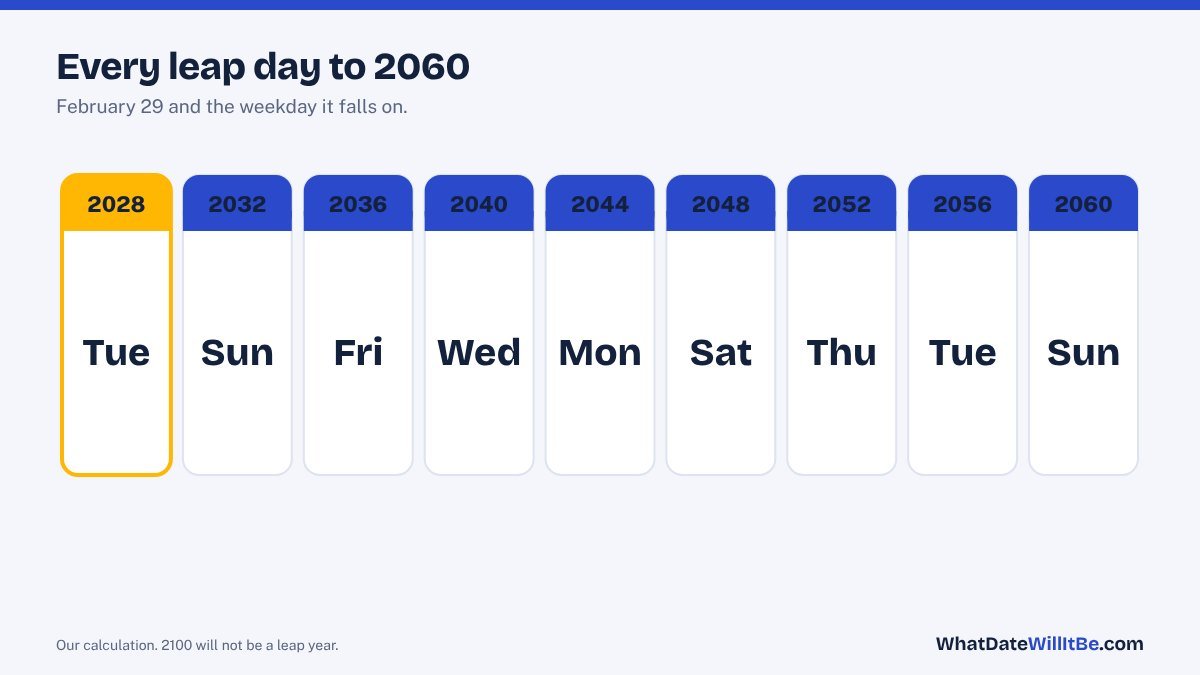
Every leap day from 2028 to 2060
| Year | February 29 falls on |
|---|---|
| 2024 | Thursday |
| 2028 | Tuesday |
| 2032 | Sunday |
| 2036 | Friday |
| 2040 | Wednesday |
| 2044 | Monday |
| 2048 | Saturday |
| 2052 | Thursday |
| 2056 | Tuesday |
| 2060 | Sunday |
What happens if you are born on February 29?
People born on a leap day usually celebrate on February 28 or March 1 in other years. For calculating age, most systems (and our age calculator) treat February 28 as the birthday in non-leap years.
Leap years in date math
A leap day changes many calculations. One year after February 29, 2028 is February 28, 2029. A date one year after any day from March 2027 to February 2028 is 366 days later instead of 365. Our leap day countdown shows exactly how long until the next one.
Sources
- Paris Observatory: An Etymological Dictionary of Astronomy and Astrophysics, “leap year rule”
- Leap day weekdays: our own calculation from the Gregorian calendar.