Which Years Have 53 Weeks? 2026 Is One of Them
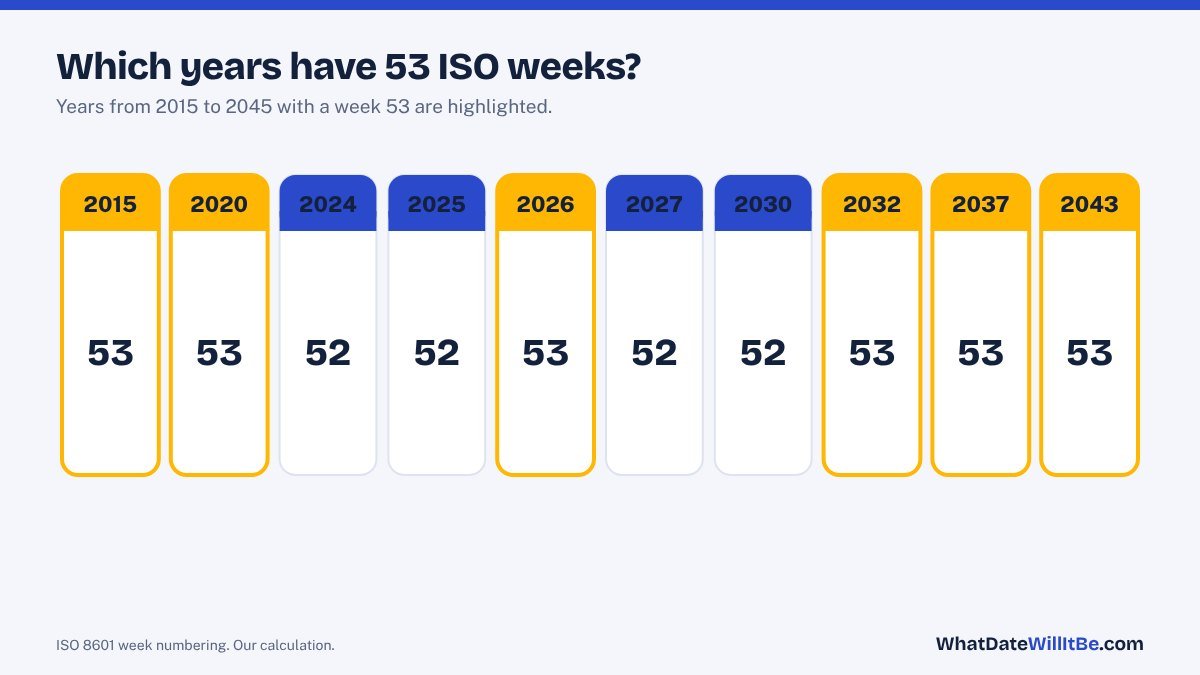
Most years have 52 weeks under the ISO week system, but some have 53. 2026 is a 53-week year, which means week 53 runs from Monday, December 28, 2026, to Sunday, January 3, 2027. The next ones are 2032 and 2037.
Key facts
- ISO years with 53 weeks: 2015, 2020, 2026, 2032, 2037, 2043.
- A year has 53 ISO weeks if it starts on a Thursday, or is a leap year starting on a Wednesday.
- That happens 71 times every 400 years, about once every 5 to 6 years.
The rule
ISO 8601 weeks start on Monday, and week 1 is the week that contains the year’s first Thursday. A year is given 53 weeks when it has 53 Thursdays: when January 1 is a Thursday, or when it is a Wednesday in a leap year.
53-week years from 2015 to 2045
| Year | January 1 | Week 53 starts |
|---|---|---|
| 2015 | Thursday | Dec 28, 2015 |
| 2020 | Wednesday | Dec 28, 2020 |
| 2026 | Thursday | Dec 28, 2026 |
| 2032 | Thursday | Dec 27, 2032 |
| 2037 | Thursday | Dec 28, 2037 |
| 2043 | Thursday | Dec 28, 2043 |
Why it matters
Payroll and retail calendars often use weeks. If you are paid weekly or every two weeks, a 53-week year can mean one more paycheck that year. Retailers on a 52/53-week fiscal calendar add a week every few years, which makes year-on-year sales comparisons awkward. Planning tools that number weeks also need a week 53 in their templates.
US week numbers are different
Many US calendars number weeks starting on Sunday, with week 1 being the week that contains January 1. Under that system, any year can have a partial week 53 or even 54. If your calendar and a colleague’s disagree about the week number, this is usually why. Our week number page uses ISO numbering and lists every week of the year with its dates.
Sources
- ISO: ISO 8601 date and time format
- Week counts: our own calculation.